Politics, society, culture, freedom, democracy, Tibet, Thailand, Indonesia, Aceh, Southeast Asia, China, human rights, and any other subjects which are of interest to either Agam of Tapaktuan, or his unruly gecko.
The author may be contacted at agam [dot] tapak [at] gmail [dot] com Posting times are Bangkok time [GMT+7 = EDT+11].
The author may be contacted at agam [dot] tapak [at] gmail [dot] com Posting times are Bangkok time [GMT+7 = EDT+11].
SEARCH THE GECKO
TIBET INFO LINKS
   |
   |

BURMA FREEDOM VIDEO

E a r l i e r P o s t s

PROTEST AT RAGYA
Ragya, Machen County, Golog Amdo
March 21, 2009
March 21, 2009
UNDER ARREST
Lhasa region or city (unknown)
Date unknown
Date unknown
D a y b y D a y
Search the web with 
M o n i t o r s




Quotation of the Day
Website content
provided by The Free Dictionary
W A I
 Our way of saying "thanks" in the Thai way. Here a nak muay Thai (kickboxer) offers respect and thanks for his teacher (wai khru) before a match. This is our local variation on the ubiquitous "hat tip" used in general blog culture.
A r c h i v e s

N e w s H e a d l i n e s
This Day in History
Website content
provided by The Free Dictionary
B l o g s

Tibet Blogs


Aqua's Dreamscapes
Beijing Wide Open
Chinese occupation of Tibet
kuala lumpur for a free tibet
Letters to the West
Life on the Tibetan Plateau
Meyul: in Exile
Precious Metal
RFA Unplugged
Shadow Tibet
The Interdependent
The Secret Tibet
The Soul of Tibet
TIBETSPACE
Tibet Talk
Tibet Will Be Free
Tibetan Studies Resources Blog
Tibetan Uprising Movement
Tibeto-logic
Voice for Tibet
Asia Blogs
2Bangkok 20 Alpha 4
American Expat in SE Asia
asiapundit
Beyond Wallacia
Burma Dialogue
Burma Digest
Burmese Bloggers without Borders
Burma-Myanmar Genocide 2007
China e-Lobby
Daai Tou Laam Diary
Far Outliers
Flaming Peacocks
Indonesia Matters
Jiwa Merdeka
Kaung Kin Ko
Macam-Macam
North Korea zone
Radio Free Nepal
Registan
Rule of Lords
Sarasonteh
Simon World
VietPundit
Iraq Blogs
HammorabiHealing Iraq
In the Red Zone
Iraq at a glance
Iraq Blog Count
IRAQ THE MODEL
Iraqi Bloggers Central
IraqPundit
The Messopotamian
Michael Yon : Online Magazine
Treasure of Baghdad
Middle East & the Stans
Across the Bay Afghan Warrior
Amarji - A Heretic's Blog
Big Pharaoh
Lebanese Political Journal
Martin Kramer's Sandbox
Muslims Against Sharia
Regime Change Iran
The Religious Policeman
SMCCDI
Syria Exposed
General Punditry
Belmont Club Best of the Web
Tim Blair
Blue Crab Boulevard
Chequer-Board
jules crittendon
Currency Lad
Democracy Project
Galley Slaves
Gateway Pundit
Victor Davis Hanson
Hot Air
INDC Journal
InstaPundit
Jihad Watch
Just One Minute
Oliver Kamm
Little Green Footballs
Llama Butchers
Mark in Mexico
Michelle Malkin
The Missal
neo-neocon
New Sisyphus
NormBlog
Oxblog
Power Line
protein wisdom
Publius Pundit
Doug Ross Journal
Sane Nation
Seeker Blog
SEIXON
Roger L. Simon
Solomonia
Stormbringer's Thunder
Don Surber
This ain't Hell
TigerHawk
Michael J. Totten
Winds of Change
ZenPundit
Eurotopia
Barce Pundit Davids Medienkritik
EuroPundits
Fjordman
Harry's Place
Iberian Notes
No Pasaran!
Zacht Ei
Can Con
Angry in the Great White North Autonomous Source
bob tarantino
Canada Free Press
Andrew Coyne
Damian Penny
Dust my Broom
Peaktalk
The Shotgun
small dead animals
Inkless Wells
Toons & Satire
Cox & Forkum Day By Day
iowahawk
Scrappleface
WuzzaDem
Media Watchers
The American Expat Backspin
Biased BBC
The Command Post
The Corner
The Daily Ablution
Diary of an anti-chomskyite
Hit & Run
HonestReporting
Oh, That Liberal Media
NewsBusters
PirateBallerina
Radio Blogger
Radio Equalizer
USS Neverdock
T i b e t
His Holiness the 14th Dalai Lama Tibetan Government-in-Exile
Tibet Information Network
Tibetan Committee for Human Rights and Democracy
International Campaign for Tibet
Canada-Tibet Committee
Phayul News
Australia Tibet Committee
Tibet Justice Center
Tibet Daily
Tibet Online Resource
Virtual Tibet Library
Dreams of Tibet
S o u r c e s
Memeorandum Snopes: Urban Legends
BBC | Monitoring
MEMRI
SITE Institute
A s i a P a c i f i c
Yahoo! News Asia The Jakarta Post
Paras Indonesia
Metro TV News Online
The Nation
Bangkok Post
Democratic Voice of Burma
Irrawaddy News
Mizzima News
BurmaNet News
Burma NewsLadder
Southeast Asia News
Sydney Morning Herald
The Australian


 Home
Home
Agam's Gecko

Monday, July 13, 2009
FURTHER VIOLENCE IN URUMQI
 'The future's so bright, I gotta wear shades.' Chinese soldiers march on a main street in Urumqi, July 13, 2009. Photo: Reuters / David Gray |
| V |
iolence flared again in Urumqi this afternoon, as Chinese soldiers gunned down at least two Uyghur men after they and a third man tried to attack the soldiers with knives. Two Uyghur men who witnessed the incident said the three had "hacked at the soldiers with big knives, and then were shot." Two Uyghurs were killed and the third was wounded. His condition is not known.
However in a later report, an Urumqi city official named Mr. Fan told Associated Press that the three attackers had been going after another Uyghur man when the paramilitary police shot them. The AP goes on to cite construction worker Zhang Ming, who said he also saw the men try to attack the soldiers. The security forces chased them, beat them and fired shots, he said.
Photos taken at the time show one policeman raising his rifle to strike a man. Beaten, the man in a blue shirt with blood on his right leg lay on the ground. Police formed a ring around him, pointing their guns up at surrounding buildings.And according to a still later dispatch from Reuters, the official Xinhua state mouthpiece has now reported the incident, and stays on-message with Mr. Fan's version. Uyghurs were attacking Uyghurs, and the People's Armed Police saved the day.
Xinhua also had more good news for China, revealing the long-awaited proof that the unrest in Uyghur country was organized by outsiders. Demonstrations against China's longstanding suppression of the Uyghurs have been occurring around the world, some of which have resulted in attacks against Chinese consulates and embassies.
"Supporters of the East Turkestan separatists started well-orchestrated and sometimes violent attacks on Chinese embassies and consulates in several countries soon after the riots occurred," Xinhua said, referring to name given to their desert homeland by some Uighurs.And there you go, what more proof could you need? Supportive demonstrations were organized in many countries, and were carried out by foreigners. Therefore the protesting students who marched in Urumqi's streets last Sunday afternoon were organized by foreigners too. It's so obvious! It couldn't possibly have anything to do with this:
"The attacks against China's diplomatic missions and the Urumqi riots seemed to be well-organized."
A Uighur security guard, who declined to give his name, said that while he did not support the violence, he understood people's frustration.A few days ago I mentioned that a Canadian journalist was among those being ejected from Kashgar, the Uyghur cultural capital in the western part of the territory. Mark MacKinnon is the Toronto Globe and Mail's Beijing bureau chief, and was in Kashgar to report on the demolishing of Kashgar's Old City by Chinese authorities. MacKinnon writes of his rushed eviction with fellow journalists here. His story on the destruction of Kashgar's Old City, for which (surprise!) the Chinese government has never applied for a well-deserved UNESCO world heritage listing, has now been published.
"Look around you -- 90 percent of all the businesses are owned by the Han," he said, standing in Urumqi's main bazaar.
"All I can do is get a job as a security guard," complained the university graduate. "The Han here can't even speak Uighur."
The Chinese government did the right thing by immediately allowing journalists into their 'New Dominion' to report on the conflict, but angry Han mobs probably didn't exactly fit into the desired narrative. An ABC news crew happened to see an attempted Uyghur lynching by a Chinese mob, which then promptly turned on the journalists.
Thirty Han Chinese men were beating a Uighur man, kicking him and punching him and hitting him with sticks. He was not fighting back but just trying to get away. Hundreds of Han Chinese were cheering the men on. Eventually, the police dragged the Uighur away and put him in a vehicle for his protection. Then, the mob turned on us. They blocked our cameras, not wanting the images of Han Chinese beating a Uighur to get out. I was pushed. Then the group surrounded us and started yelling. They pushed us back up a highway ramp where we were shooting. They yelled that western journalists were biased against the Han Chinese and that we should delete our footage. One man tried to grab our camera and then pulled out a baton and held it over his head as if he were going to hit us. We turned around and ran. The oddest part of the whole experience was that there were swarms of police and troops around and none of them were really trying to break up the fight.The Boston Globe has another fine Big Picture series on the ethnic violence in East Turkestan. It's good to see those big format images which make it easier to see people's faces. Some of it is disturbing, but the gallery offers a prior warning over the images which you may choose to skip.
Last night I watched Alim Seytoff, the Vice President of the Uyghur American Association, interviewed on C-SPAN's Washington Journal. The thirty minute interview, with video footage and phone-in callers can be viewed here.
I'll be in Indonesia this week, so I'm unlikely to post again until next weekend. Pro-Uyghur demonstrations have been held today in Surabaya and Jakarta, so I'm looking forward to learning what the Indonesian views are on the situation. (I'm also looking forward to ketoprak, sate, tempeh, nasi goreng, ikan bakar, etc. Heh.)
.
Friday, July 10, 2009
CHINA'S OTHER COLONY EXPLODES
 Keeping the peace in Sinkiang. Yes, those are crossbows. Photo: AFP |
| T |
he Chinese Empire's conquered colonies are restless. More than a year after the latest Tibetan uprising, protest still continues in Tibetan areas and China's responses are as intolerant and repressive as ever. Now a spark has ignited the dry tinder of rage in Uyghurstan, which the Communist empire calls the Xinjiang Uyghur Autonomous Region. A protest march in the regional capital Urumqi turned into a violent anti-Chinese riot, and protests have also been reported in Kashgar and several other towns.
The vast culturally Turkic area of central Asia was once divided up between two competing imperial powers — neither of which had anything much in common with the people of the region. West Turkestan was conquered by the Russian Empire in the mid 19th century, around the same period that the Qing Dynasty Empire (Manchus who had previously subsumed China and were not themselves Chinese) conquered East Turkestan. After the Russian Revolution the communists held on to the empire's central Asian colonies, converting them into Soviet Socialist Republics (Turkmen, Uzbek, Tajik and Kyrgyz SSR's). After the fall of Soviet communism, these all became independent countries.
But the Turkic Muslims in the eastern part of this vast region had a different fate. With the fall of the Qing Dynasty and the advent of the new Chinese Republic in 1912, the fringes of the empire began to fall away. The Tibetans evicted the Chinese and declared their independence, while eastern Turkestan fell under the control of various warlords and ethnic insurgencies. An East Turkestan Republic existed briefly in 1933-34 until a Russian-backed Chinese warlord retook control. A second East Turkestan Republic was declared (in what is now northern Xinjiang) in 1944. With the advance of the Chinese communist revolution in 1949 and the People's Liberation Army's advance into southern Sinkiang, Chinese Republican government officials fled to other countries or surrendered to the communists.
Uyghur resistance to the CCP continued, and the leaders of the East Turkestan Republic travelled to the Soviet Union in 1949 — where they were advised to cooperate with the Chinese communists. The five leaders boarded a plane in Kazakhstan, enroute to Beijing. The plane crashed, killing all on board. With all their experienced leaders now gone, the remaining figures in the East Turkestan government agreed to incorporate their republic into the "Xinjiang Uyghur Autonomous Region" of China. KGB files released after the collapse of Soviet communism revealed that the East Turkestan leaders had been killed on orders from Stalin — and in accordance with a deal the Soviet dictator had made with the new Chinese dictator, Mao Tse Tung.
This is admittedly a thumbnail sketch of Uyghurstan's recent history, but we can surely better appreciate the depth of resentment on view over the past five days if we have at least an outline of the initial relations between the Uyghurs and the Chinese communists. Unfortunately for the latter, you never have a second chance to make a first impression. By his own rhetoric, Mao was a great liberator of humanity. But by his practice, he was determined to recover every square inch of land ever (even marginally) colonized by long-past Chinese empires. Mao evidently inherited the imperialist gene from the earlier emperors, including the non-Chinese ones.
And Mao handed that gene down to his political descendants who have taken and run with it. At the time of the communists' victory in China's civil war, the Han Chinese comprised around 5-6% of the population in East Turkestan. Today, with its longstanding policy of transmigration into "minority" regions, the CCP has turned that around. The Han migrants now comprise around 40% of the entire "autonomous" region — three times the size of France. In the major commercial city of Urumqi (current population 2.4 million), the Han make up around 75% now.
The trouble on late Sunday afternoon began with a student protest march through Urumqi (a Dzungar name meaning "beautiful pasture"). The students were photographed in a non-violent procession, chanting and carrying Chinese flags, making their way toward People's Square. After that, the sequence of events is murky (I held off making a post on this until a clearer understanding of what happened on Sunday evening could be known — it still isn't). Foreign journalists were permitted to flood into the city the next day, but reliable accounts of the time between the protest march and the (at least) 156 deaths that night are hard to find.
Whatever happened, a non-violent protest march became — in the space of a few hours — an extremely violent anti-Chinese riot. Given the recent history of crowd control in Tibet, one might surmise that the smashing of shops and cars could have been triggered by a violent dispersal of the student protesters. Some hours later, Uyghur youths were hunting for Hans to beat and kill. Learning the exact sequence of events will be essential in understanding how this could happen, yet this short period (before journalists were present) is the murkiest of the past five days.
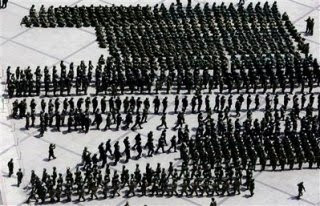 Troops assemble in People's Square, Urumqi, July 8, 2009. Photo: AP / Ng Han Guan |
One thing we do know about the spark for all this, is that it originated thousands of miles away. The students were marching to demand justice for some of their compatriots who had been lynched by a Han mob in Guangdong, a major industrial province in southern China. Those riots had been sparked by rumours initiated by a disgruntled Han factory employee, which claimed that Uyghur boys had raped some Han girls. At least one of the Uyghurs killed by the mob was reportedly a girl. After the riot and lynchings, it was found that the rape rumour had been false.
Rumours can be deadly, and perhaps the Chinese authorities are learning this. If China actually had a vibrant free press, the chances that one hateful person could start a baseless rumour and have it widely believed (with such deadly consequences) might be close to nil. The starting requirement is an unfettered press with journalists willing and able to investigate anything. Then it will still take time for various media outlets to establish themselves as trustworthy, or not. Until such time as citizens can trust the press, they will fall for rumours.
Of course the Guangdong riot was not covered by the Chinese media in any detail, since the authorities believe that hushing up uncomfortable events is the best course. This is a nutritious environment for growing bigger and better rumours. Authorities claim that only two Uyghurs were killed by the lynch mob, but with no trustworthy journalism to dig up the story, Uyghurs were also inclined to believe rumours. Following the Urumqi riots, I came across at least three separate accounts by Uyghurs claiming that the Guangdong mob had killed over 600 of their people, and that the bodies had been chopped up and dumped into garbage bins. That's some fine rumour fuel for what would follow.
The Chinese government must learn that an independent and trustworthy press is the only thing which can remedy this situation. But government officials continue to believe that they must control absolutely everything, especially information. This ridiculous attitude will cause many more deaths until the CCP learns their lesson.
The clearest accounts of the Guangdong incident come from a secretly-conducted interview with some of the hundreds of Uyghur factory workers now held under the protection of Chinese police. They are not allowed to leave the place where they are held, much less go home. One of the workers had a hidden cell phone, though they are not permitted to communicate to the outside. Radio Free Asia's Uyghur service was able to establish contact and spoke with three of them. Why aren't Chinese citizens permitted to know what happened that night, from the victims' perspective?
But even the deadly rumour from Guangdong can't be blamed for everything that happened in Urumqi. A "Strike Hard" campaign (Tibetans know all about those) was launched in Xinjiang in April. Many have been arrested over the past few months for taking part in "illegal religious activities" and regional Party leaders have been flying into their familiar Cultural Revolution-style tirades well before the Sunday night riot.
For whatever reason, the Chinese are not precisely following their Tibet pattern in responding to this incident. The day after the initial riot, foreign journalists were welcomed to travel to Urumqi and were afforded the only open internet connections in the city (at their hotel). But the authorities were unable to completely dispense with their impulse to control the message, and they set up guided "tours" for the press — apparently believing they had things well in hand. Suddenly, out of the lanes and alleys of an impoverished Uyghur neighbourhood, dozens of women and children appeared and wailed over the disappearance of their husbands, fathers and sons. Yet another staged media event (Labrang, Jokhang...) had gone awry.
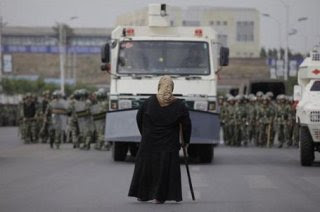 Tursun Gul walks with her crutch toward the might of the Chinese state, July 7, 2009. Photo: agencies |
The only video I've found of this event is in a report by Tania Branigan and Dan Chung in The Guardian. Watch for the soldiers and their equipment backing up at Tursun Gul's approach, in the opening seconds of that clip. Peter Foster of the Daily Telegraph tells her story. Without the accidental presence of foreign media, her act of courage would not have been known by the world.
But there was more to come. That same day, a new mob was taking over the streets. Angered by their own army's failure to protect them from the angry, marginalized and colonized minority, the Chinese citizenry organized vigilante gangs. Armed with crude weapons, they went hunting for minorities to kill.
It was too quiet. At two o'clock on another hot, dry afternoon they strolled up towards the People's Square. Some were in smart shirts and ties, others in jeans and trainers. In their hands were iron bars, knives, staves of wood, metal chains and nunchuks, golf clubs and meat cleavers, lengths of piping, shovels and axes.For the rest of the week, Chinese riot police and soldiers have played cat-and-mouse with the roving gangs of vengeance-seekers and the defiant remaining pockets of Uyghurs willing to challenge them. At some points the two groups were hurling rocks at each other over the heads of security forces. Heavy military deployments were made around Uyghur neighbourhoods in attempts to keep the Hans out — not always successful. But over those few days the vigilantes were kept on the move and unable to congregate in one place, earning the security forces an unaccustomed praise for their tactics from some foreign media members.
Little by little the numbers swelled, almost imperceptibly. Within half an hour there were hundreds of Han Chinese on the streets of Urumqi – then thousands. At first the talk was of self-defence. Then it turned to vengeance.
 A Chinese vigilante joins a mob attacking Uyghurs on July 7, 2009, showing off his multi-tasking capabilities in beating and documenting with one hand. Photo: AP / Ng Han Guan |
Some things, though, will never change under the CCP. Prominent Uyghur intellectuals disappear, presumably by police action (and even if he lives in far-off Beijing). The initial unexpected openness toward foreign media has an expiry date, as news agency reporters have now been ordered out (including a Canadian in Kashgar). Being that Friday is the most important Muslim prayer day, it's only sensible for the government to padlock the mosques and order everyone to pray at home, right? That was the decision this morning, but evidently that one won't fly right now. Urumqi's Uyghur population was able to get into at least some of their mosques today.
Also on the 'never change' list is the standard, number one response of the CCP — blame some outsider for your own deficiencies. With Tibet, of course, everything is always the Dalai Lama's fault. Party functionaries dream up conspiracies of plotting death and destruction, with His Holiness always at the centre. They have "plenty of evidence" but none is ever presented — only elaborate passages in official speeches lifted straight out of the Cultural Revolution, disseminated far and wide on the state controlled media mouthpieces. For the Uyghurs? That's easy: Rebiya Kadeer did it all. What would these vile repressive dictatorships do without a small but tough woman to blame for everything? (Is Hu taking lessons from Burma's Than Shwe?)
And let us not forget the clever strategy of vowing to execute as many as possible — that's always a smart move, and quite helpful at calming inflamed passions. It worked so well in Tibet, right? Oh wait... well, it couldn't hurt to try, eh?
A good source for keeping up with events in Uyghurstan is The New Dominion, a well-written and apparently well-connected website which has followed this episode from its first hours. The latest article is a letter from an anonymous foreign traveller who flew into Kashgar from Urumqi just before the riot. There is an account of the Kashgar protest, and the crackdown that followed it. Chinese CCPatriots will be pleased to know that it is depressing; if you want to experience Uyghur culture, you'd better hurry. The Motherland is burying it as quickly as possible.
Striking up a conversation with a police officer, the letter-writer asks him his thoughts on the situation. The officer replied that everything would be fine. "You know, in the next ten years, we’ll just send more Han here and that’ll just end the problem once and for all."
.
